
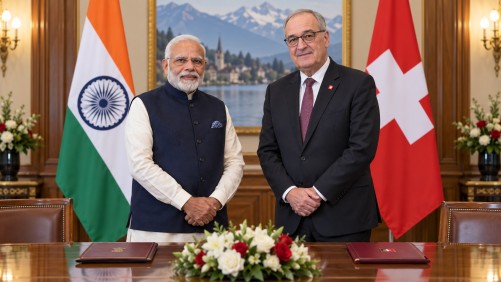
India and Switzerland have fortified their bilateral relations by signing five agreements aimed at enhancing cooperation in trade, technology, and mobility. This development follows discussions between Indian Prime Minister Narendra Modi and Swiss President Guy Parmelin on Monday, where they explored opportunities for collaboration across various sectors, including defence and nuclear energy.
The agreements focus on migration, mobility, and the exchange of young professionals, as well as advancements in research and technology transfer. A notable aspect of the collaboration is the migration and mobility partnership, which aims to address irregular migration and human trafficking. This agreement includes provisions for multiple-entry visas valid for up to five years and renewable permits for students.
In addition, a dedicated agreement will facilitate the exchange of young professionals, allowing up to 300 individuals annually from each country to gain temporary employment and language experience abroad. Such initiatives are expected to bolster professional ties and enhance mutual understanding.
Economic cooperation is also set to expand, with India seeking improved market access for its exports, particularly in agricultural products, pharmaceuticals, textiles, and engineering goods. Switzerland, meanwhile, is encouraging investment in sectors such as biotechnology, life sciences, banking, and sustainability from Indian entities. These efforts coincide with the first anniversary of the India-European Free Trade Association (EFTA) Trade and Economic Partnership Agreement, aiming to boost trade and employment between India and the EFTA countries.
The two nations have also agreed to explore joint research projects in health, clean energy, and space, alongside promoting advancements in transportation technologies, sustainable infrastructure, and electric vehicles. These initiatives are poised to strengthen collaboration between research institutions and businesses in both countries.
During their discussions, Modi and Parmelin also addressed global and regional issues, including the ongoing conflicts in Ukraine and West Asia. Both leaders emphasized the importance of dialogue and diplomatic efforts to foster peace and stability in these regions.