
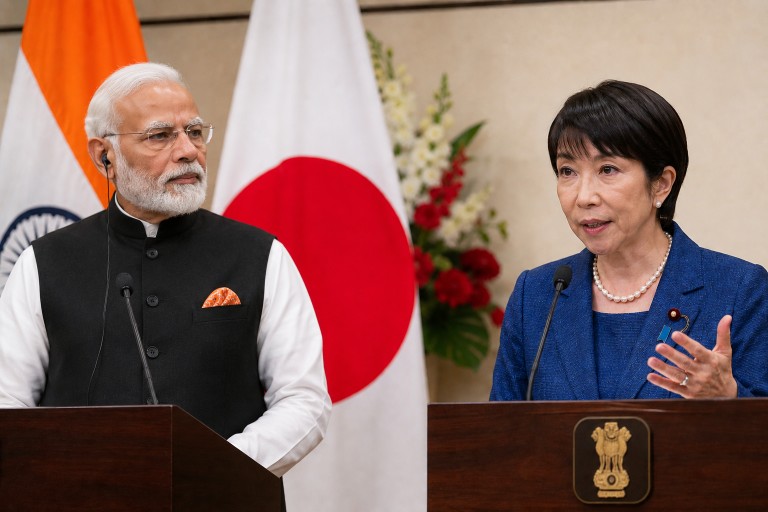
During a recent visit to New Delhi, Japanese Prime Minister Sanae Takaichi found herself at the center of a translation mishap involving Indian Prime Minister Narendra Modi. The confusion arose at a joint press conference held on July 2, when Takaichi mistakenly quoted Modi as calling her his “beautiful sister.” The Japanese government has since clarified that this was due to an error in interpretation.
Officials have explained that Modi addressed Takaichi as “my sister” in Hindi, which was translated into English as “my younger sister.” However, during the complex process of relay interpretation from Hindi to English and subsequently to Japanese, the phrase was incorrectly rendered as “beautiful sister.” Operating under the assumption that the translation was accurate, Takaichi repeated the phrase, expressing that she and Modi had agreed to maintain a brother-sister relationship.
The Japanese government has emphasized that the mistake stemmed from the intricacies of simultaneous relay interpretation, a process that can be prone to errors. They have assured that the incident has not impacted diplomatic relations between Japan and India. Importantly, Indian officials have not expressed any concerns or objections regarding the mistranslation, indicating that bilateral ties remain unaffected.
This incident highlights the challenges of international diplomacy where language barriers can sometimes lead to unintended interpretations. Nevertheless, both countries appear to have navigated this minor hiccup with understanding and without any diplomatic fallout. The focus remains on strengthening the relationship between Japan and India, underscoring their mutual respect and cooperation.